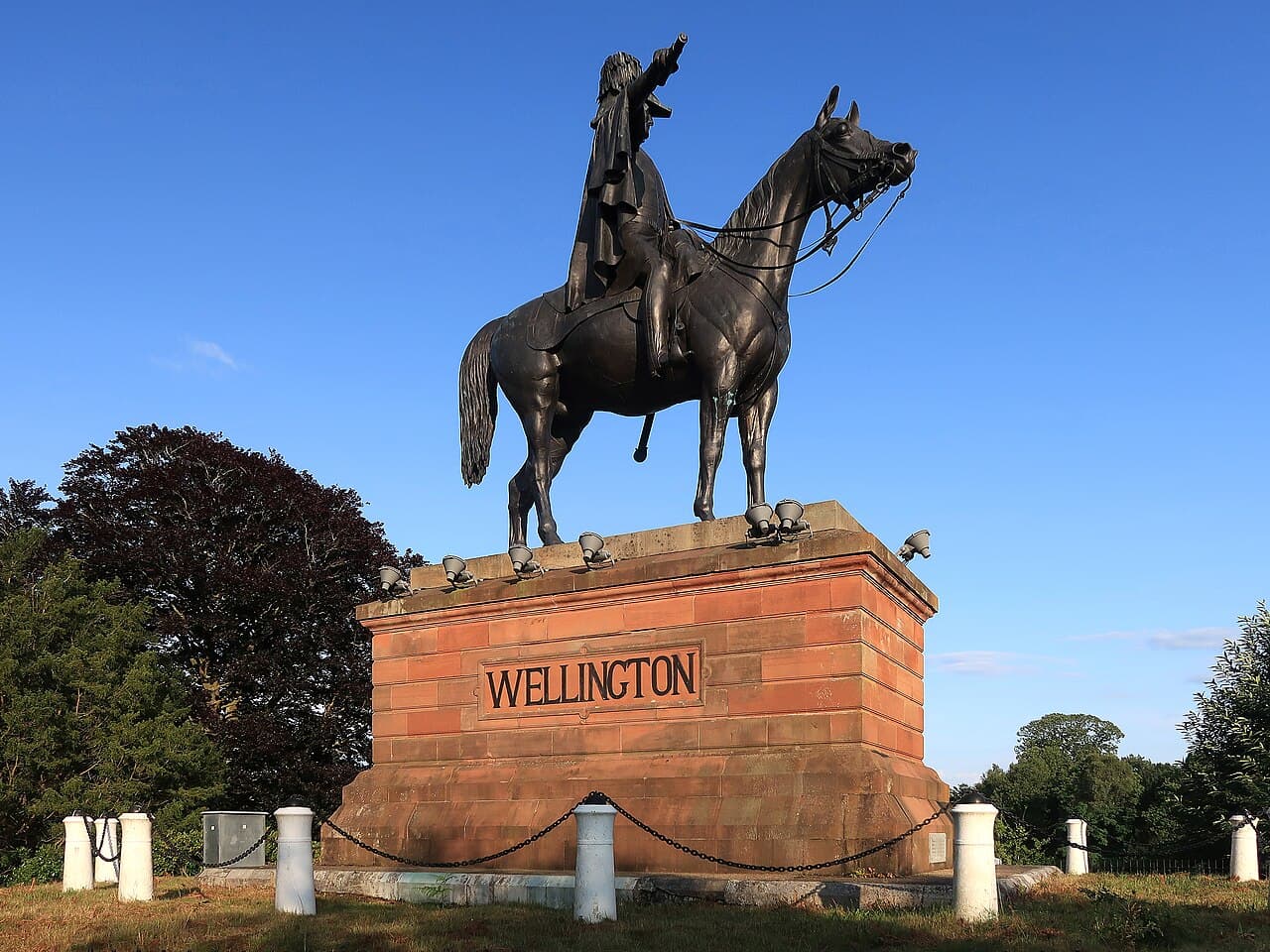
The Wellington Statue on Round Hill, Aldershot
A 30-foot bronze Duke of Wellington that London did not want and Aldershot adopted.
The Wellington Statue was made by Matthew Cotes Wyatt, stands about 30 feet high and weighs around 40 tonnes. It first stood on the arch at Hyde Park Corner in 1846 and was moved to Round Hill, Aldershot, in 1885. It is Grade II listed and sits beside the Garrison Church of All Saints.
You can see it from some distance and, up close, it is even bigger than you expect. The Wellington Statue is Aldershot's best-known landmark and appears on the town's welcome signs, according to the Friends of the Aldershot Military Museum.
Who made it, and how big is it?
The sculptor was Matthew Cotes Wyatt. Historic England's list entry describes an 1846 bronze equestrian statue of the Duke of Wellington "on a standing horse with his right arm extended holding a baton".
Wikipedia gives the dimensions as:
- Height: 30 feet (9.1 m)
- Length, nose to tail: 26 feet (7.9 m)
- Girth: 22 feet 8 inches (6.91 m)
- Weight: about 40 tonnes
It was billed as the largest equestrian statue in Britain. The Duke is mounted on Copenhagen, the horse he rode at Waterloo. Wikipedia adds that Wyatt used cannon captured at Waterloo for the bronze, that modelling took three years and that the casting began in May 1840.
London, 1846
The statue was hauled to Hyde Park Corner on a specially built carriage with 10-foot wheels, pulled by Scots Fusilier Guards and twenty-nine horses, then lifted on to the top of Decimus Burton's triumphal arch in 1846.
It was not universally loved. The Friends record that the statue was criticised as out of proportion with the arch, and Wikipedia says Burton himself disliked it.
Why it left
When road changes in the early 1880s meant the arch had to be moved, the statue came down. The Friends say Queen Victoria stepped in to prevent it being broken up, and Wikipedia has it stored in Green Park while its future was decided. The Prince of Wales suggested Aldershot, describing it as the right place for "Britain's greatest general" in "Britain's greatest Army camp".
Aldershot, 1885
The statue was re-erected on Round Hill next to the Garrison Church of All Saints. The Prince of Wales picked the site, and in August 1885 the statue was formally handed over to the Army. Historic England's entry records the same move: "removed to the present site 1885". It is surrounded by 16 upright guns joined by a continuous chain, which form an oval around the stone plinth.
Where London argued over it, Aldershot took it to heart. The statue has stayed a symbol of the town ever since.
Listing and restoration
The monument was listed Grade II on 29 March 1973 (list entry 1303266). A major restoration began in early 2004, when overgrown vegetation was cleared and the bronze was re-bronzed. The Friends of the Aldershot Military Museum were among the local supporters.
How to visit
- Where: Round Hill, beside the Garrison Church of All Saints. Historic England gives the address as Claycart Road, Aldershot, GU11.
- Look for: brown tourist signs from the main roads. We have not confirmed an official car park or access arrangement for the site, so check the signs on the day. Round Hill is within the Garrison area, and the nearest official facility we can confirm is the Aldershot Military Museum on Queens Avenue, which has its own free car park.
- Cost: none that we are aware of, but check before you go, especially if the Garrison is holding an event.
A good half-day: the statue, the museum and a walk through Aldershot town centre afterwards. For more background, read our history of Aldershot.
Checked 5 October 2026. Details change, so follow the official links above before you travel.
Frequently asked questions
- Who sculpted the Wellington Statue in Aldershot?
- Matthew Cotes Wyatt (Historic England list entry; Wikipedia).
- How tall is the Wellington Statue?
- About 30 feet (9.1 m) high and 26 feet long, weighing around 40 tonnes, according to Wikipedia.
- When did the Wellington Statue move to Aldershot?
- It was re-erected on Round Hill in 1885 and formally handed to the Army in August 1885, after standing on the Hyde Park Corner arch from 1846.
- Is the Wellington Statue listed?
- Yes. It is Grade II listed as the Wellington Monument (list entry 1303266, listed 29 March 1973).
- Where exactly is it?
- On Round Hill beside the Garrison Church of All Saints. Historic England's address is Claycart Road, Aldershot, GU11.
Share this article